Learn the mechanics, master the Gig. Complete rules reference for the Cyberpunk 2077 TCG.
Win Conditions
Win Condition
Gig Dice Victory
If you control 7 or more Gig Dice in your Gig Area at the start of your turn, you win. The game checks this before the Ready step. With only 6 dice per player, you must steal at least one Gig from your rival.
Win Condition
Overtime
Overtime begins after two consecutive turns in which both players start with an empty Fixer Area (usually once each player has taken 7 turns). During Overtime, the moment you have 7 or more Gig Dice in your Gig Area you win immediately, even mid-effect.
Lose Condition
Deck Out
If you must draw a card while your deck is empty, you lose immediately. Having 0 cards left is not a loss by itself; the loss happens when you attempt the draw (including the mandatory draw in your Start Phase).
Game Setup
- Each player draws 6 cards as their starting hand.
- Your 3 Legends start face-down in a random order in the Legends Area.
- All 6 Gig Dice start in the Fixer Area.
- Mulligan: You may mulligan once: return your whole opening hand to your deck, shuffle, and draw 6 new cards. The first player declares and resolves their mulligan before the second player decides.
- The first player starts with 2 of their Legends already spent.
Turn Phases
Each turn has a Start Phase and a Main Phase, followed by an automatic End of Turn check. The Start Phase is a fixed, mandatory sequence; during the Main Phase you may take these actions in any order and any number of times unless noted, and pass the turn whenever you are not mid-action:
Start Phase
- →Check for Victory: If you control 7 or more Gig Dice, you win. This check happens before anything else in your turn.
- →Start-of-Turn Effects: Remove effects that last "until the start of your next turn", then resolve any "at the start of your turn" effects.
- →Ready Spent Cards: Turn all your spent (sideways) cards in your Legends Area, Field, and Eddies Area back to ready (upright).
- →Draw a Card: Draw the top card of your deck. If your deck is empty when you attempt this draw, you lose immediately. There is no maximum hand size.
- →Roll In a Gig: Choose a die from your Fixer Area, roll it, and place it in your Gig Area preserving the rolled value. You may only choose the d20 when it is the last die left in your Fixer Area.
Main Phase
- →Sell a Card: Once per turn, sell a card from your hand that has a Sell Tag. Reveal it to your rival, then place it face-down and ready in your Eddies Area. Each Eddie can be spent for 1 €$ toward a cost.
- →Call a Legend: Once per turn, pay 1 €$ to flip one of your face-down Legends face-up. You choose which face-down Legend to flip; unless an effect has let you look at it, you don't know which one it is. The Legend keeps its orientation (spent or ready) and any CALL trigger resolves immediately. You may also Call a Legend as a reaction during your rival's attack.
- →Play Cards: Reveal a card from your hand and pay its cost (top-left corner) using Eddies and/or Legends. Spend a Legend (turn it sideways) to pay 1 €$, face-up or face-down, except that a face-up Legend without a Sell Tag can't be spent this way. Units and Legends enter the Field with Lag and can't attack this turn unless they have ADRENALINE or GO SOLO.
- →Play a Legend to the Field: Pay a Legend's cost to move it from your Legends Area to the Field as a Unit. It enters with Lag in the same orientation it had in the Legends Area. Legends with a null cost (–) can't be played this way.
- →Activate an Effect: Use activated effects on friendly Units or Legends, paying any activation cost (a Spend icon means "spend this card"). Lagging Units can't use Spend effects.
- →Attack: Spend a ready, non-lagging Unit to attack a spent rival Unit (a Fight) or your rival's Gig Area if it holds at least one Gig (a Steal). ATTACK triggers resolve first, then your rival gets a React Step: they may Call a Legend, use a ready BLOCKER to redirect the attack, or play QUICK effects. Fight: higher power wins, ties defeat both. Steal: 1 Gig, plus 1 more per 10 power. You may attack with as many ready Units as you like.
End of Turn
- →End-of-Turn Effects: Resolve "at the end of your turn" effects, then remove effects that last "this turn". All Units lose Lag.
- →Overtime Check: If both players have now started two consecutive turns with an empty Fixer Area, Overtime begins. In Overtime, reaching 7 Gigs wins on the spot.
Combat
- Lag: Units and Legends enter the Field with Lag. Lagging Units can't attack or use Spend effects. Lag wears off at the end of the turn. ADRENALINE and GO SOLO let a card attack through Lag.
- Fight: Only spent rival Units can be attacked. Compare total power (base power plus equipped Gear and modifiers). Higher power wins and the loser is defeated. Ties mean both Units are defeated. A 0-power Unit can never defeat anything.
- Steal: When attacking a rival Gig Area that holds at least one Gig, take any die from it. A Unit steals 1 Gig plus 1 more for every 10 power (so 10+ power steals 2). A 0-power Unit steals nothing.
- React Step: After ATTACK triggers resolve, the defender may Call a Legend (costs 1 €$, 1 per turn), redirect the attack with a ready BLOCKER, or play QUICK effects, in any order.
- Sell: Limited to 1 card per turn.
- Legend Spending: Spend any of your Legends (turn sideways) for 1 €$ each, face-up or face-down. A face-up Legend without a Sell Tag can't be spent for €$. Legends ready again every turn.
Card Types
Legend
Leaders of your crew. Your 3 Legends start face-down in a random order in the Legends Area and provide your deck's RAM Limits. Spend a Legend (turn it sideways) to pay 1 €$, face-up or face-down, though a face-up Legend without a Sell Tag can't be spent for €$. Once per turn you may Call a Legend (pay 1 €$ to flip one face-up). Any Legend with a cost can be played to the Field as a Unit by paying that cost; GO SOLO Legends enter ready and can attack immediately. A Legend on the Field counts as both a Unit and a Legend. Legends can never go to the hand, deck, or trash: if one would, it's removed from the game instead.
Max per deck: 3

Unit
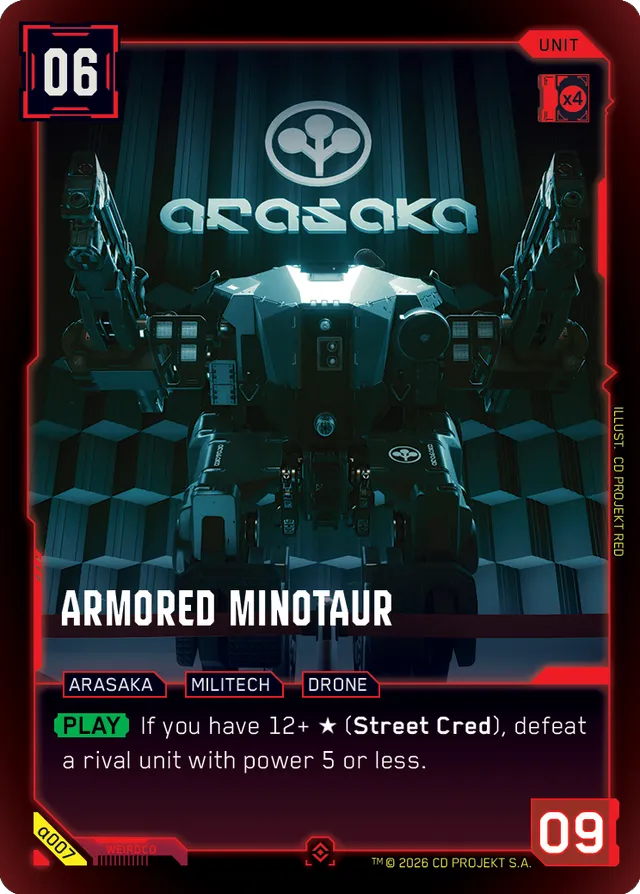
Crew members placed on the Field. Reveal, pay the cost, and place the Unit ready on the Field, where it enters with Lag (it can't attack or use Spend effects until your next turn). Units attack spent rival Units (Fights) or the rival's Gig Area (Steals). There is no limit to the number of Units on your Field.
Can attack
Program
One-time effects. Reveal it, pay its cost, resolve it, then move it to your Trash. Play Programs during your Main Phase, or during your rival's attack if the Program has QUICK.
Goes to Trash on play

Gear
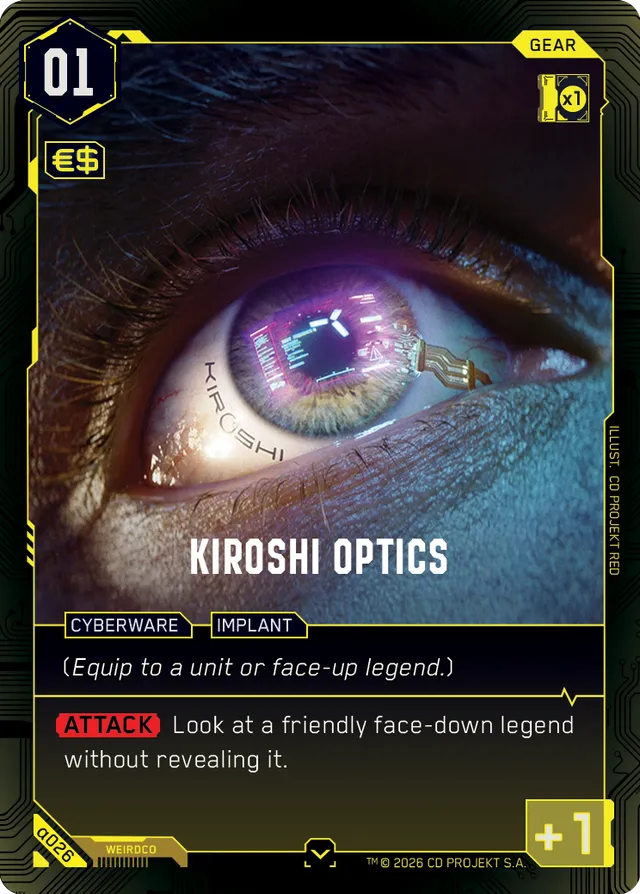
Equipment that attaches to a friendly Unit or a friendly face-up Legend, adding its power and the effects in its bottom textbox to that card. There is no limit on Gear per Unit. When the equipped Unit or Legend leaves the Field, its Gear moves with it and is no longer equipped.
Keywords & Triggers
Keywords
Blocker: "When a rival Unit attacks, you may spend this Unit to redirect the attack to it instead." Used as a reaction during the React Step with a ready Unit. The Blocker becomes the defending Unit, so a Steal becomes a Fight and no Gig is stolen, even if the Blocker loses. Lag doesn't stop it: a Unit can block the turn it's played. Another Blocker can redirect the same attack again, but the Unit being attacked can't use its own BLOCKER, and a Legend's BLOCKER works only once it's on the Field.
Go Solo: "Pay this Legend's cost to play it as a ready Unit. It can attack this turn. If it leaves the Field, remove it from the game." It's still a Legend on the Field, and only the attack skips Lag: its Spend effects wait until your next turn. A Legend with GO SOLO can also be played to the Field normally.
Adrenaline: "This Unit can attack the turn it's played." It ignores Lag for attacking only: the Unit still can't use Spend effects that turn, and all other attack-target rules still apply.
Quick: "You may also activate this effect (or play this Program) as a reaction to a rival Unit's attack." You still pay any costs, and you can still use it in your own Main Phase. A Program with only QUICK can be played during the React Step by paying its cost. QUICK doesn't let a Unit use a Spend effect the turn it's played, and a rival's QUICK can't be answered with one of yours.
Timing Triggers
Play: "When you play this card, [...]" The effect becomes pending as soon as you meet all requirements for playing that card type.
Attack: "When this Unit attacks, [...]" Triggers when you spend the Unit to declare an attack. All ATTACK effects resolve before your rival's React Step.
Call: "When you flip this Legend face-up through the Call a Legend action, [...]" The effect becomes pending when the Called Legend is revealed.
Defeated: "When this Unit is defeated, [...]" The effect becomes pending once the Unit is declared defeated and moved to the Trash.
Resources
€$ Eddies
Eurodollars (€$), the currency of Night City. Every card has a cost in the top-left corner. Pay costs by spending Eddies (face-down cards in your Eddies Area, made by selling cards with a Sell Tag) and/or Legends in your Legends Area, each worth 1 €$. Legends are not Eddies. Effects that reduce what you pay can't reduce it below 1.
◆ RAM
A deck-building limit, not a resource you spend in play. Each card has a RAM value in one color. Your deck's RAM Limit in a color is the sum of your 3 Legends' RAM in that color, and every main-deck card's RAM must be less than or equal to the limit for its color. RAM Limits are locked once the deck is built.
☆ Street Cred
The sum of all Gig Dice values in your Gig Area (dice still in the Fixer Area don't count). Some card effects require a minimum Street Cred (☆). With no Gigs in your Gig Area your Street Cred is null, which is not 0 and counts as lower than 0.
Gig Dice
Six polyhedral dice track your Gig progress. Each turn, pick one die from the Fixer Area, roll it, and place it in your Gig Area. Collect 7 dice in your Gig Area to win.
d44 sides
d66 sides
d88 sides
d1010 sides
d1212 sides
d2020 sidespick last
Play Areas
Fixer Area: All 6 Gig Dice start here, stacked d4 through d20 from the bottom up. Each Start Phase, choose one die, roll it, and move it to your Gig Area. The d20 may only be chosen when it's the last die here. Dice here are not under your control and don't count toward Street Cred.
Gig Area: Holds the Gig Dice you control, including any stolen from your rival. Their sum is your Street Cred. Start your turn with 7 or more dice here to win. A rival Gig Area with at least one Gig is a valid attack target.
Field: Where Units (and Legends played as Units) live. Cards enter the Field ready but with Lag. Ready Units can't be attacked; only spent rival Units are valid targets. There is no Field size limit.
Eddies Area: Face-down cards that act as currency. Sold cards enter here face-down and ready. Spend (turn sideways) an Eddie to pay 1 €$. Spent Eddies ready again in your Start Phase. There is no limit on Eddies.
Legends Area: Holds your 3 Legends face-down in a random order. Spend any number of them for 1 €$ each, face-up or face-down, except a face-up Legend without a Sell Tag. Call a Legend once per turn (pay 1 €$) to flip one face-up. Face-up Legends can use their Spend effects here and can be equipped with Gear.
Deck: Your face-down draw pile of 40 to 50 non-Legend cards. Draw 1 in each Start Phase. If you must draw from an empty deck, you lose immediately.
Trash: Face-up discard pile for defeated Units, resolved Programs, and discarded cards. Legends never go here; they're removed from the game instead.
Deck Building
- Exactly 3 Legends per deck, no two sharing a name. Subtitles don't count: V - Streetkid and V - Corporate Exile are both named V and can't be in the same deck
- 40–50 cards in the main deck (not counting Legends)
- Maximum 3 copies of any card with the same name and subtitle, counting all printings together, and your sideboard if you have one
- Your 3 Legends set your RAM Limits: the limit in each color is the sum of their RAM in that color. Every main-deck card's RAM must be at or below the limit for its color
- For Constructed tournaments, a sideboard of exactly 7 cards: no Legends, and every card within your RAM Limits. See Tournament Play
- Only cards that are legal at tournaments: those the official card database lists as legal in Standard
- Recommended: at least 30% of cards with Sell Tags for economy
- Recommended: enough steal denial (Blockers and the like) to be 80% to hold one by turn 3
Tournament Play
Official events follow the Tournament Rules on top of everything above.
Formats: Constructed: you build your deck in advance. Every competitive event (Night City District Opens, Edgerunner Open Regionals, the Black Sapphire Invitational and the World Championship) is Constructed, as are store Night City Brawls and Showdowns. Sealed: you build from packs opened at the event, as at Pre-Releases and Beta events, with at least 30 cards in up to 3 colors, RAM ignored and any number of copies; your unused cards are your sideboard.
Constructed decks: 3 Legends with different names, a main deck of 40 to 50 cards and a sideboard of exactly 7, with at most 3 copies of a card across the deck and sideboard and every card within your RAM Limits. Legends can't be sideboarded. Stores running quick best-of-1 play without a sideboard.
Legal cards: Cards from the official sets, from Welcome to Night City (Beta and Retail) on, each from its release day. Not legal: the Alpha Kit (except its Nova Rare cards), test prints, Jackie & V - Chooms to the End, and the textless promos Lucyna Kushinada - Fresh Beginnings, David Martinez - Built Different and Rebecca - Having a Moment until a card with the same name and subtitle is printed. Errata overrides printed text. Cards in any official language are allowed, and English governs rulings.
Matches: Competitive events play best-of-3: 50-minute Swiss rounds and 75-minute top-cut rounds. Stores may instead run 30-minute best-of-1 rounds. Play order for the first game is chosen at random (in top cut the higher seed chooses); after that, the loser of each game chooses. When time is called, the current turn finishes and each player takes one more turn within 5 minutes; then a player with 7 or more Gig Dice wins and otherwise the game is a draw (in top cut, play goes on until one player has more Gigs).
Sideboarding: In best-of-3, after games 1 and 2, each player has 2 minutes to swap cards with their sideboard. Swaps are one for one, so the main deck keeps its size and the sideboard stays at 7. In competitive best-of-1, players reveal their Legends to each other, then get 3 minutes to sideboard before the game. After each match, return your deck and sideboard to your registered list.
Decklists: Competitive events take decklists on Melee.gg: your name, your Melee.gg or CyberpunkTCG ID, your 3 Legends, your main deck and your 7-card sideboard. You must play the deck you registered. ripperdeck's Melee export pastes straight into the submission.
At the table: Bring one set of six dice (d4, d6, d8, d10, d12 and a d20 that isn't a spindown) and, at Showdowns and competitive events, identical opaque sleeves for your deck and sideboard, with your Legends sleeved so they can be told apart from them. Your rival may cut or shuffle your deck and shuffles your Legends, which you then place face-down from left to right.
Ready to build your first deck?